
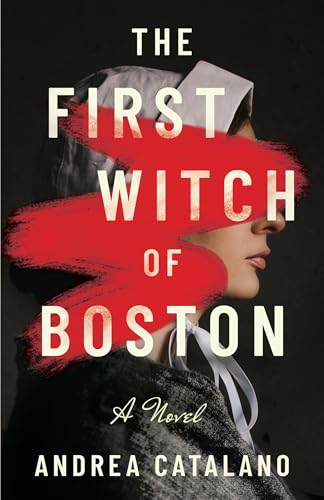
In The First Witch of Boston by Andrea Catalano, Margaret “Maggie” Jones and her husband, Thomas, flee London for the Massachusetts Bay Colony in 1646 to escape prior witchcraft accusations. Struggling against rigid Puritan expectations, Maggie’s bold nature and healing talents ultimately make her the first woman executed for witchcraft in colonial Boston.
Set in the austere and tightly controlled confines of 1646 Charlestown, the historical fiction novel is framed around Thomas discovering his wife’s journals. The narrative alternates between Thomas’s present-day memories of their tumultuous relationship and Maggie’s own firsthand writings detailing her life, her craft, and the tragic events that led to her trial.
In England, Maggie established herself as a gifted apothecary, herbalist, and midwife. However, her outspoken personality and uncanny intuitive ability to diagnose ailments before they were visible—along with a controversial past involving a malicious and influential local widow—forced the couple to seek a fresh start across the Atlantic. In the New World, they hope for a quiet life, especially with a child on the way.
Unfortunately, the Massachusetts Bay Colony offers little sanctuary for a free-spirited and educated woman. The deeply religious and patriarchal Puritan society leaves very little room for female independence. As Maggie goes about her days delivering babies and using her knowledge of herbs to heal the sick, the comely but treacherous Widow Hallett begins to sow seeds of doubt among the townsfolk. When personal tragedies strike the community—such as failed crops, sick livestock, and the tragic death of an infant Maggie previously treated—the superstitious neighbors are quick to blame the outsider.
Driven by religious hysteria, fear of the unknown, and envy, the community rebrands Maggie’s natural healing remedies as dark spells. Her tendency to speak her mind and resist the silent submissiveness demanded of Puritan wives is subsequently weaponized against her. She is eventually arrested and subjected to a harrowing, unfair trial presided over by Governor John Winthrop.
With the deck stacked against her, the legal proceedings function as a total farce based largely on spectral evidence, uneducated gossip, and communal paranoia. Despite Thomas’s desperate attempts to clear her name and defend her honor, the societal momentum against independent, unorthodox women is too strong.
Grounded in actual historical diary entries and colonial court records, the novel serves as a heartbreaking exploration of injustice, women’s history, and the devastating human cost of being different in an intolerant society. Ultimately, Maggie faces a tragic and inevitable end, becoming a victim of mass hysteria and a patriarchal system terrified of female knowledge.