
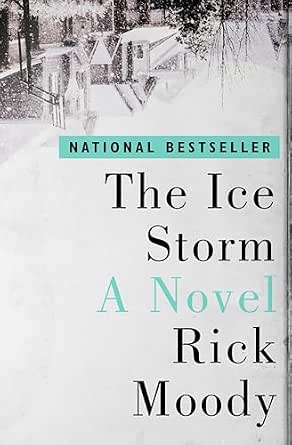
Rick Moody’s acclaimed novel, The Ice Storm, was written in 1994. It explores the moral and emotional collapse of two affluent, upper-middle-class families in New Canaan, Connecticut, during the turbulent Thanksgiving weekend of 1973. Set against the backdrop of the Watergate scandal, shifting political climates, and the onset of the sexual revolution, the narrative follows the intertwined lives of the Hoods and the Williamses. The story serves as both a biting suburban satire and a profound tragedy.
The Hood family—Benjamin, Elena, and their teenage children, Paul and Wendy—are plagued by quiet desperation. Benjamin is drowning his professional and personal inadequacies in alcohol and an affair with his married neighbor, Janey Williams. Elena, emotionally alienated, engages in petty shoplifting and considers an affair with a long-haired minister. The parents’ marital and personal decline forms the dark epicenter of the narrative.
Meanwhile, their teenage children are navigating the chaotic freedoms of their parents’ generation. Paul, a boarding school student, attempts to woo a wealthy girl in Manhattan and experiments with psychedelic drugs. His sister Wendy, highly intelligent yet cynical, challenges the boundaries of her environment through sexual experimentation. Wendy’s interactions with Janey’s sons, Mikey and Sandy, blur the lines of their shared suburban ecosystem.
The tension in the community escalates to a breaking point during a neighborhood “key party”. At this supposedly harmless, liberal-minded gathering, adults trade partners by drawing keys from a fishbowl. As Benjamin and Janey, along with the other respectable suburbanites, agree to go home with whoever’s keys they draw, a severe, freak winter storm descends upon Connecticut. The rapidly dropping temperatures lead to treacherous driving conditions, trapping the adulterous adults in the wrong beds and stranding them far from their true homes.
Simultaneously, the children face their own terrifying realities as the weather worsens. While driving on icy roads, Paul is delayed in Manhattan, forcing Wendy and the Williams boys to grapple with unsupervised teenage exploration, substance abuse, and dangerous behavior in the harsh, sub-zero conditions. The impending storm functions as a dual force: a literal meteorological disaster causing violent senselessness and a visceral metaphor for the emotional isolation and fragility of the characters’ carefully curated lives.
The climax of the novel occurs as the physical peril of the storm collides with the psychological unraveling of the community. The extreme cold forces a grim reckoning, culminating in a devastating tragedy that shatters the fragile illusion of privilege in the exclusive suburb. Ultimately, the characters are faced with the stark realization that their desperate search for escape and meaning in an unmoored world has led to irreversible relational damage. Stripped of their protective layers of wealth, suburban protocol, and denial, the survivors are left profoundly changed, forced to confront the wreckage of their choices in the aftermath of the storm.