
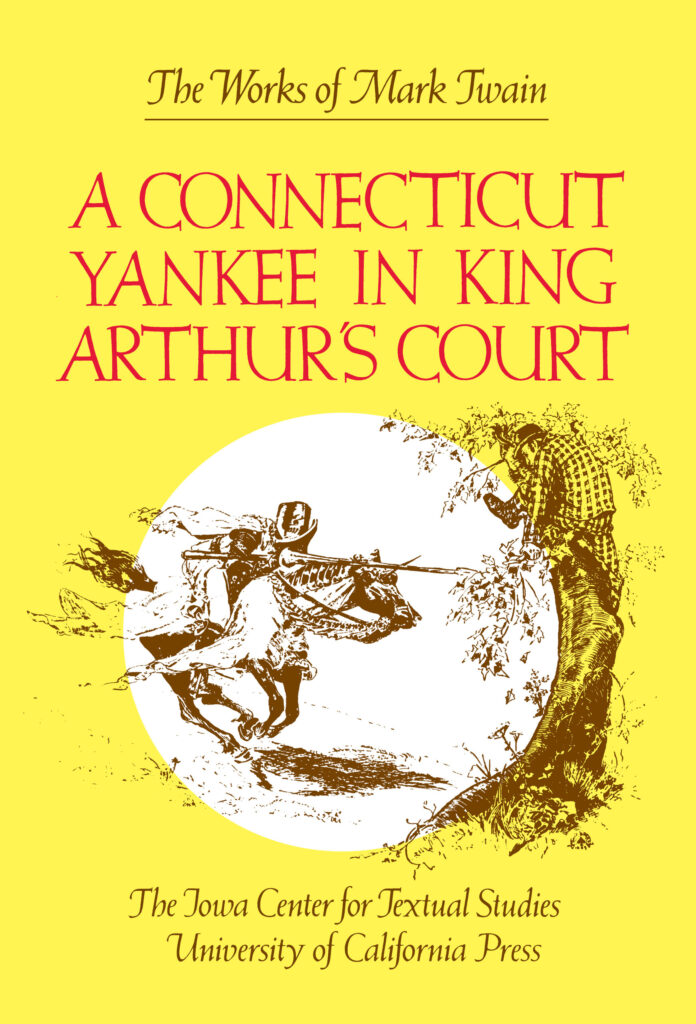
Technically, Mark Twain’s 1889 satirical novel A Connecticut Yankee in King Arthur’s Court is only set in New England for the opening and ending sequences. The rest is takes place in in England, in the year 528. The story follows Hank Morgan, an ingenious 19th-century mechanic from Hartford, who sustains a head injury and awakens in 6th-century England. To survive, he uses his advanced scientific knowledge to simulate magic.
The narrative begins when Hank, after being transported to Camelot, is initially sentenced to be burned at the stake. Remembering an upcoming solar eclipse, he predicts the event and claims to have blotted out the sun. Terrified of his apparent power, the court spares him and dubs him “The Boss.” Hank soon positions himself as the king’s chief minister, second in power only to King Arthur.
Using his modern, industrial ingenuity, Hank quietly introduces a wave of technological and social reforms. He builds schools, factories, and roads, establishes a patent office, and introduces newspapers, telephones, and electricity. His ultimate goal is to dismantle the tyrannical feudal system and the corrupting power of the Catholic Church, hoping to guide medieval England toward a democratic republic.
Throughout his time as “The Boss,” Hank undertakes various adventures. He travels the kingdom with a maiden named Sandy, repeatedly exposes the fraudulent miracles of his rival, the wizard Merlin, and even ventures out in disguise with Arthur to experience the harsh realities of peasant life. Witnessing the extreme poverty and absolute subjugation of the commoners transforms the King’s worldview, driving Arthur to promise the abolition of serfdom once they return to power.
Tragedy strikes when Hank’s modernizing efforts clash with the entrenched chivalric and religious powers. While Hank is temporarily away from Camelot, the discovery of Queen Guinevere’s affair with Sir Lancelot sparks a devastating civil war. The Church places the kingdom under an interdict, turning the superstitious masses against Hank and his progressive technologies.
In a climactic final stand, Hank and his loyal band of young students—whom he had secretly trained in modern warfare—use electric fences, land mines, and Gatling guns against an army of thirty thousand knights. They secure a swift, brutal victory, but trap themselves behind a massive wall of decaying enemy corpses. Following the slaughter, a mortally wounded Hank is left trapped in a cave as Merlin, disguised as an old woman, casts an enchantment over him.
The framing device of the novel reveals that this tale is an extended manuscript read by a tourist (representing Twain) at Warwick Castle. When the tourist returns to check on the dying Hank, he finds him delirious, fervently wishing to return to his 6th-century wife and child, trapped forever in the memories of a dream world. Through its satirical blend of science fiction, comedy, and dark tragedy, the novel serves as a critical dismantling of romanticized medievalism while critiquing the limits of unchecked technological progress.