
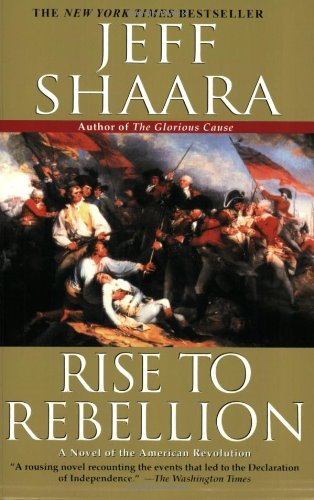
Jeff Shaara’s historical novel Rise to Rebellion, written in 2001, brings the American Revolution to life, detailing the pivotal years between the 1770 Boston Massacre and the 1776 Declaration of Independence. The narrative explores this critical era through multiple shifting perspectives, capturing the internal conflicts and ideologies of both colonial and British leaders.
The story opens on March 5, 1770, with the chaos of the Boston Massacre. Rather than being swayed by mob hysteria, principled lawyer John Adams risks his reputation and his livelihood to defend the British soldiers accused of murder. Through his tireless dedication to the rule of law, Adams secures an acquittal, cementing his status as a moderate, deeply thoughtful voice who struggles with the realization that war is becoming inevitable.
Simultaneously, Benjamin Franklin serves as a colonial agent living in London. Initially attempting to bridge the widening gap between the British Crown and the colonies, Franklin endures hostility and prejudice from the King’s Privy Council. His mounting frustration causes him to pivot from a loyal British citizen to a man who recognizes the necessity of colonial independence.
On the British military front, General Thomas Gage is tasked with quelling the unrest in Boston without sparking total war. Misunderstanding the fierce resolve of the colonists, Gage’s stringent policies and miscalculations—including the fateful attempts to seize munitions at Lexington and Concord—ultimately hasten the outbreak of open hostilities.
Meanwhile, in Virginia, George Washington balances life as a wealthy planter with his duties as a colonial military figure. Despite his past experience in the French and Indian War, Washington recognizes the daunting challenge of leading an untrained, impoverished, and disjointed group of militiaman against the world’s most formidable army. Nevertheless, he rises to the occasion to accept command of the Continental Army.
As the political maneuvering transitions to outright warfare, the novel immerses the reader in the tactical details and grueling realities of the Battle of Bunker Hill and the Siege of Boston. Beyond the grand scale of the battlefield, Shaara provides an intimate look into the personal tragedies of the era, illustrating how the push for liberty caused irreparable divisions among friends and families—notably seen in Franklin’s fractured relationship with his loyalist son.
The sweeping saga culminates in 1776 as the Continental Congress convenes to sever ties with King George III completely. The novel captures the gravity of this collective leap into the unknown, detailing the eventual reading and signing of the Declaration of Independence. Ultimately, the book highlights the profound human and philosophical sacrifices required to transform a collection of fractured colonies into the United States of America.