
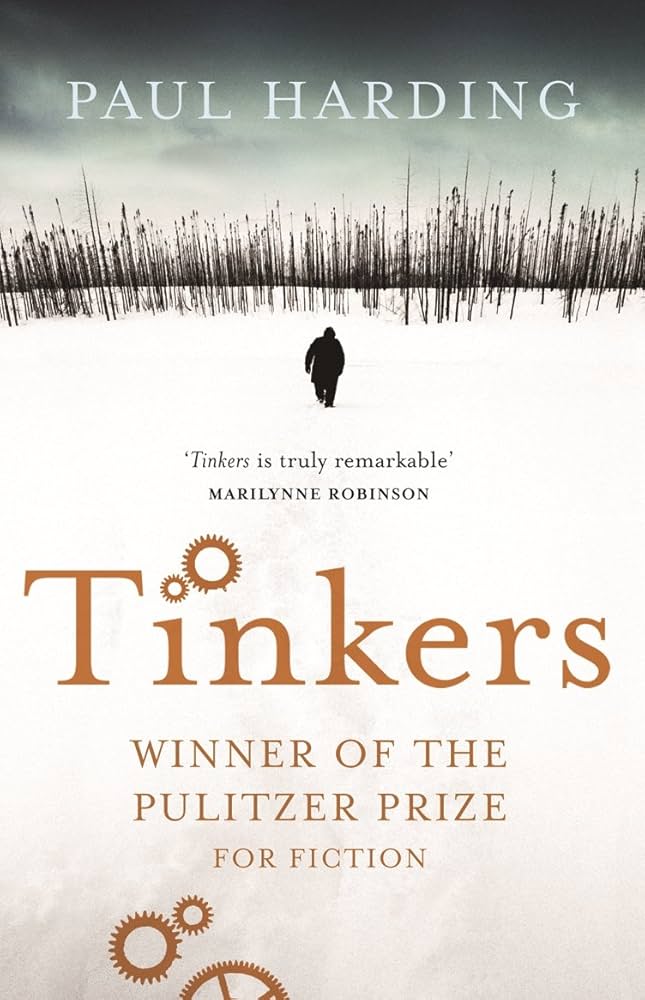
Tinkers, written in 2009, is the Pulitzer Prize-winning debut novel by Paul Harding. It’s a lyrical, meditative exploration of memory, mortality, and the generational bonds between a dying man and his itinerant father. The narrative is not strictly linear, instead functioning as a collection of fragmented memories and sensory experiences that collapse the constraints of time, moving between the final days of a New England clock repairman and the rustic, challenging life of his father in early 20th-century Maine.
The story opens with George Washington Crosby, an elderly man in his 80s, lying on his deathbed in a hospital bed set up in his living room in Enon, Massachusetts. As George lapses into delirium, his mind drifts back to the past, reconstructing his life and the lives of his ancestors—a “shifting mass” of mosaics, as he calls it. He is surrounded by his wife, children, and grandchildren, yet he is internally retreating into his memories of childhood and, specifically, his father, Howard Aaron Crosby.
Howard was a tinker, a travelling salesman who navigated rural Maine with a mule-drawn wagon, selling household goods and repairing pots. Howard is depicted as a quiet, dreamy, and poetic man who loved the natural world, but he was also plagued by severe epilepsy. His seizures were misunderstood and terrified his wife, Kathleen, who felt trapped by their poverty and Howard’s lack of practicality, leading her to eventually seek medical advice about placing him in an institution.
Harding weaves in a central traumatic memory from George’s childhood: on Christmas in 1926, Howard suffered a violent seizure while carving a ham. In the ensuing panic, Howard accidentally bit George’s hand, a violent, accidental wound that forever marked George’s perception of his father and family fragility.
Realizing his presence was detrimental to his family’s stability, Howard leaves his wife and children to live in Pennsylvania, changing his name and starting a new life, never to return home, a decision that leaves a profound emotional void in George’s life.
Through George’s memories, the novel also delves into the life of Howard’s father—George’s grandfather—a Methodist minister whose gradual descent into madness and subsequent disappearance leaves a legacy of loss.
The novel’s title refers to both Howard, the literal tinker, and George, who tinkers with antique clocks, a hobby that becomes a metaphor for understanding the intricate mechanism of time. In his final hours, George compares his dying body to a clock winding down. The book concludes with George, in his final delirium, recalling a brief, quiet reunion with his father, Howard, in 1953, offering a sense of closure to their long separation. Tinkers is a “symphonic