
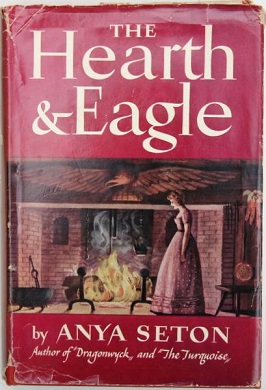
The Hearth and Eagle, written by Anya Seton in 1948, is an ambitious historical novel that chronicles the life of Hesper Honeywood, a passionate, headstrong woman living in the rugged fishing town of Marblehead, Massachusetts. The novel serves as both a personal saga of love and tragedy and a historical narrative of a New England coastal community. The central focus of the book is really Marblehead itself as the village charts its evolution from a 17th-century Puritan settlement to a 19th-century industrial fishing hub, and eventually to a modern resort town.
Hesper Honeywood is born into a family with deep roots in Marblehead, descending from Phebe Honeywood, who established the family inn—named the “Hearth and Eagle”—in the 17th century after her husband was paralyzed. Most of the story focuses on Hesper as she grows up in the mid-19th century and longs for excitement beyond her mundane life running the inn with her practical, stern mother and her ineffectual, dreamy father.
Hesper’s life is defined by dramatic turning points and tumultuous relationships. Her first love, Johnnie, a young fisherman, is killed during the Civil War, marking the first of several profound losses. Seeking escape, she marries a bohemiam artist and moves away, but the marriage is ill-fated, resulting in a miscarriage, abandonment, and a subsequent divorce. Drawn back to her ancestral home, she eventually marries Amos Porterman, a wealthy but cold businessman who moved his factory to Marblehead, bringing modernization to the traditional town.
Hesper enjoys a brief period of luxury as one of Marblehead’s wealthiest women, though she often feels unfulfilled. Then tragedy strikes again when a devastating fire destroys the town and ruins Amos, who dies shortly after in despair. Left with little but the historic, dilapidated inn, Hesper finds her strength. She takes over the management of the Hearth and Eagle, rebuilding it and becoming the independent breadwinner her ancestors were.
The novel skillfully weaves in local history, including the rise and decline of the shoe industry, the Underground Railroad, and the town’s transformation into a summer community for the wealthy.
Seton, who discovered her own ancestors in Marblehead, vividly portrays the daily struggles, risks, and resilience of its citizens.
By the end of the narrative, Hesper realizes that the multi-generational strength of the Honeywood women lies in their endurance, inner resolve, and connection to their home and history. The “Hearth and Eagle” stands as a symbol of the tenacity required to survive the sea and the tumultuous history of New England