
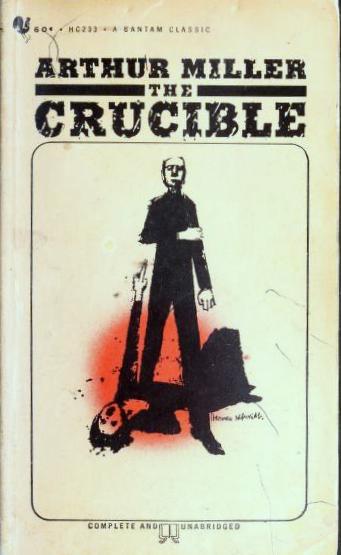
Technically this is a play, not a novel. But it very much can be read and enjoyed like a book.
Arthur Miller’s The Crucible, written in 1953, is a powerful dramatic work set against the backdrop of the Salem witch trials of 1692. It was written as a direct allegory for the anti-communist “Red Scare” and McCarthyism of the 1950s, but it can be interpreted as a warning against any type of hysterical “group think” that clouds the minds of a community.
The story unfolds in a small Puritan village where rigid religious authority, fear, and personal grudges create a perfect storm for mass hysteria. The plot begins with Reverend Parris discovering his daughter, Betty, his niece, Abigail Williams, and several other girls dancing in the woods with his slave, Tituba. Betty falls into a mysterious, unresponsive state, prompting rumors of witchcraft to consume the village. Seeking to protect her own reputation after being fired by John Proctor’s wife, Elizabeth, for having an affair with John, Abigail seizes control of the situation. She and the other girls begin falsely accusing innocent townspeople of communicating with the devil, igniting a wave of hysteria that gives them unprecedented power.
John Proctor, a well-respected farmer, tries to ignore the madness, battling his own guilt over the affair. However, the chaos hits home when Elizabeth is accused by Abigail, who is motivated by jealousy and a desire to take Elizabeth’s place. The witch trials quickly spiral out of control, fueled by long-standing personal vendettas, land disputes, and paranoid religious leaders like Deputy Governor Danforth and Reverend Hale, who demand confessions.
Proctor, in a desperate attempt to save his wife and end the court’s blind faith in the girls, brings his servant, Mary Warren, to confess that their accusations are fake. But Abigail, sensing her power slipping, turns the court against Mary. To prove Abigail is a liar, Proctor forces himself to admit his adultery to the court, ruining his own reputation to reveal her motives. Unfortunately, in a tragic turn, Elizabeth, trying to protect her husband’s name, lies about the affair, allowing the court to reject Proctor’s testimony.
By the final act, Abigail has vanished with Parris’ money, and a disillusioned Reverend Hale tries to save those accused. The court pressures Proctor to sign a false confession of witchcraft to escape the gallows. Proctor briefly agrees, wanting to live for his family, but he cannot allow his signed confession to be public, as it would dishonor his name and condemn his friends. In the play’s climax, he tears up the confession. He chooses to hang rather than sacrifice his integrity, finding a “shred of goodness” in his defiance. The play ends as Proctor and others go to their deaths, with the community left broken by the catastrophic consequences of fear and hysteria.
The Crucible does not perfectly mirror the events of the Salem witch trials because it was written as an allegory for a wider range of social issues. But those trials and their aftermath continue to haunt Massachusetts as something that should never have happened – yet did. The Crucible is a fascinating read, and one of those works that continues to spark debate and anger long after it was written.