
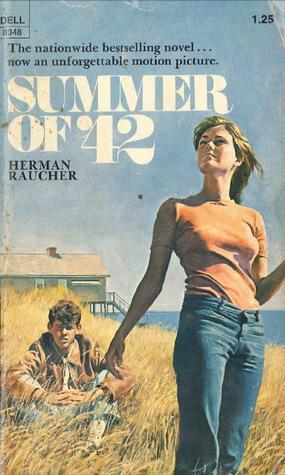
This is a memorable story that can, at times, be dirty, sappy, and heavily nostalgic. It also paints a fascinating picture of the New England home-front in the war-ravaged year 1942. One could also argue about whether this quasi-novel belongs on our list of New England based novels, because it’s based on the semi-autobiographical screenplay by Herman Raucher, who then wrote this novel based on that story. The book was released before the movie came out, and it was a bit of an early-1970s phenomenon, setting up an excellent, and much talked-about, box-office run for the movie.
Summer of ’42 is a poignant coming-of-age story that looks back at a pivotal summer on a fictional New England island during the early days of World War II. The island itself is Nantucket-like, but with hints of the Maine coast.
Fifteen-year-old Hermie, along with his best friends Oscy and Benjie, struggles with the hormonal angst of adolescence, focusing on sex-obsessed misadventures while being largely disconnected from the war raging elsewhere. Hermie, however, is a romantic idealist, distinguishing him from his friends, particularly the slightly older and brash Oscy.
Hermie falls profoundly in love with Dorothy, a beautiful twenty-two-year-old woman whose husband is away fighting as a pilot. While his friends focus on adolescent pursuits, Hermie fixates on Dorothy, offering to help with tasks like bringing in groceries to spend time with her. As the summer progresses, Hermie attempts to navigate his awkward transition into adulthood.
The boys experience numerous humorous, often embarrassing, failures in their pursuit of girls and sexual maturity. Despite the comedic misadventures, the core of the story remains Hermie’s tender, one-sided, and intensely emotional attachment to Dorothy, who views him as a sweet, helpful young boy, unaware of the depth of his adoration. This is what keeps the movie from being just a typical teen story.
The idyllic, sleepy summer takes a tragic turn toward the end of August. Dorothy receives a telegram informing her that her husband has been killed in action, shot down over France. Devastated, she meets Hermie by chance on the beach and, in her intoxicated, vulnerable state, brings him back to her cottage, where she seduces him.
In the novel, this moment is portrayed less as a triumph of adolescent fantasy and more as a desperate, comforting act of emotional solace for the grieving war bride. Following their encounter, Hermie returns the next day to find the cottage deserted. Dorothy has fled the island, leaving a note tacked to the door that acknowledges the “terrible tragedy” of the previous night and suggests he will eventually find a proper way to remember what happened. The encounter forces a premature end to Hermie’s innocence, separating him from the childish preoccupations of his friends.
The novel closes with the older narrator reflecting on that bittersweet summer, noting that he never saw Dorothy again. In a final, somber note, it is revealed that Oscy was killed in the Korean War, emphasizing the fleeting nature of their youth and the harsh realities of the era. The book is a tender, often funny, yet deeply melancholy account of a time that “was the summer when Hermie was fifteen… and when he was lost forever.”
Though a pop culture phenomenon in the first half of the 1970s, the novelization went out of print and slipped into obscurity over the decades.